 November 13, 2026
Cold Chain Monitoring: A Practical Guide for 2026
On 1 October 2026, a retail customer complained that a Kayem shipment had arrived warm. The company traced it back to a warehouse cooler that had drifted out of range. 16 days later, 1.58 million pounds of ready-to-eat meat and poultry were under a Class I recall.
Manual rounds happen once a shift. A quick walk-through can’t catch a temperature spike that ruins a shipment in minutes. This is exactly the gap automated cold chain monitoring is designed to close.
What Is Cold Chain Monitoring?
Cold chain monitoring is a system that watches over the condition of temperature-sensitive goods all the time. The system keeps an eye on temperature, humidity, vehicle location and door activity. Frozen food, medical products and vaccines are all items that need temperature monitoring to stay safe and keep their quality. Cold chain monitoring must follow these products at every step: at production, in storage, during transport, at delivery and finally when the customers receive them.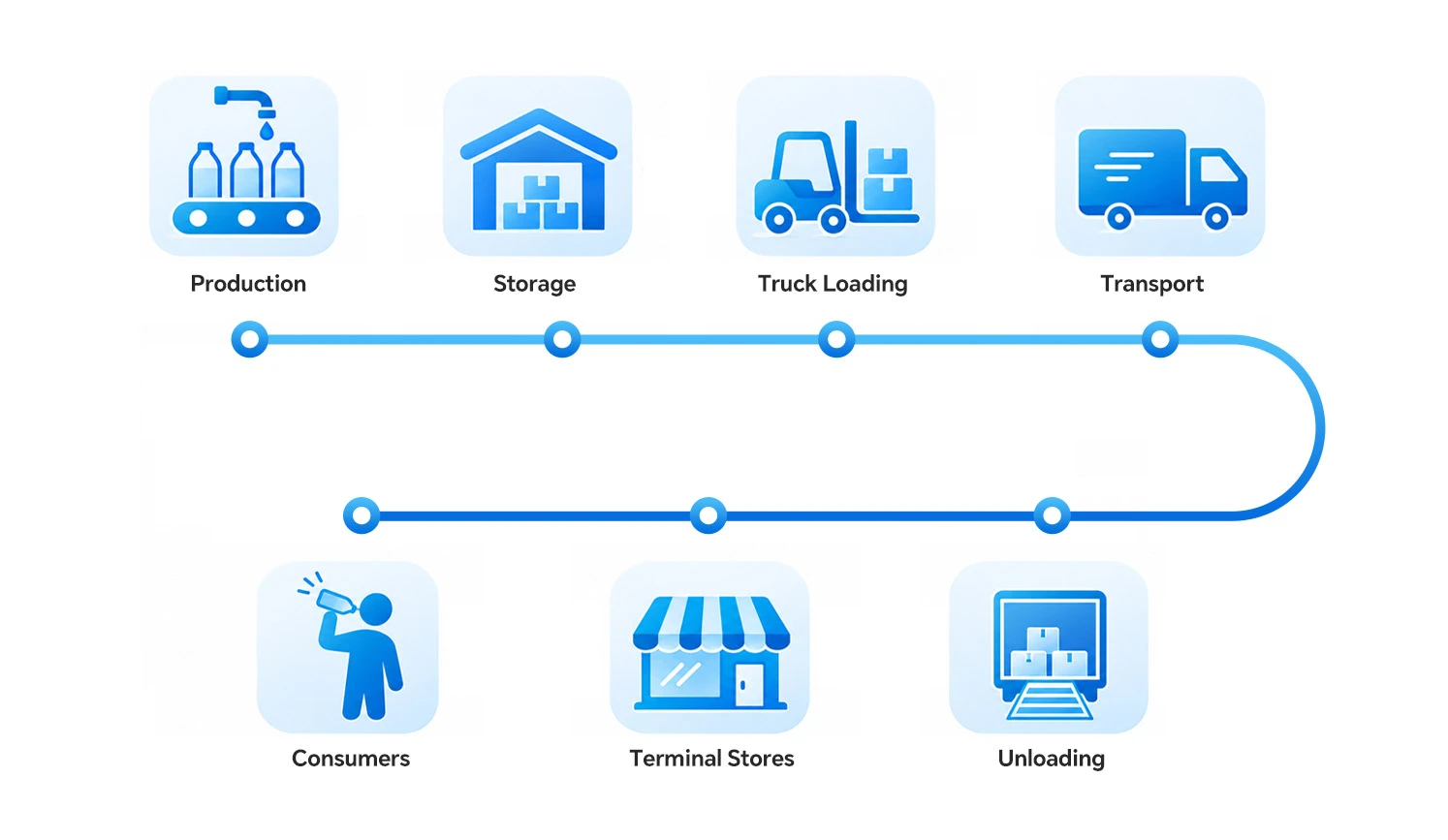
Main Components and Working Principles of Cold Chain Monitoring
cold chain monitoring system depends on four parts that work together:
- Sensors: Sensor are the heart of cold chain monitoring. The devices have different types such as data loggers, wireless sensors, and sensor probes. They are put inside trailers, cold rooms or containers to keep track of temperature and humidity.
- Connectivity & Gateways: Connectivity devices act as bridges. They collect data from sensors and send it to the Cloud using cellular (4G/LTE), Wi-Fi, Bluetooth (BLE) or LoRaWAN®.
- Cloud Platform: The Cloud Platform is the control center. The Cloud Platform receives data, checks it against configured thresholds, and stores timestamped records for audits and compliance.
- User Interface (Dashboards & Alerts): The interface shows managers real-time conditions, lets them view charts, and sends an alert by SMS, email, or mobile app when something goes wrong.
How the Data Flows:
Sensors keep collecting data all the time. That data gets sent to the Cloud. The Cloud Platform goes through the readings. If there is any deviation the system sends an alert away. The team gets notified so they can act fast while the cargo is still, on the way. At the time every single reading is saved permanently. This creates an audit trail. It helps with insurance claims and makes sure everything meets regulatory requirements.
Comparing Cold Chain Monitoring Technologies
There is various technology applied in cold chain solutions. The differences live in recurring fees, and where the technology actually works.
| Technology | Recurring Fees | Real-Time? | Best For |
| Passive data logger | None | Read after delivery | Short one-way trips |
| 4G/GPS tracker | Monthly SIM/data plan | Yes | Long-haul fleets |
| BLE sensor | None (gateway required) | Near-real-time | Cold rooms, store freezers |
| LoRaWAN® sensor | None (one gateway per site) | Near-real-time | Warehouses, large cold storage |
Passive loggers cost almost nothing. They record accurately, but the data only becomes readable after delivery. They are useful for post-incident investigation but too late for intervention.
A 4G tracker provides real-time location and temperature data. That matters when a trailer is 800 km from the depot. Each unit needs its own SIM card and a monthly data plan. Battery life is measured in months, not years.
BLE devices cost little to run and last for years. Their range tops out at 10–30 meters. That makes them ideal for a freezer aisle and nearly useless in a moving cab without an on-board gateway.
LoRaWAN® offers up to 5 km outdoor range, with one gateway covering a full warehouse. There are no SIM cards or per-unit data fees. The tradeoff is that the gateway infrastructure must be deployed on site. That makes LoRaWAN® economical for hundreds of sensors in one place—a distribution center, a retail chain. It’s overkill for a single trailer.
Applications of Cold Chain Monitoring
Warehouse
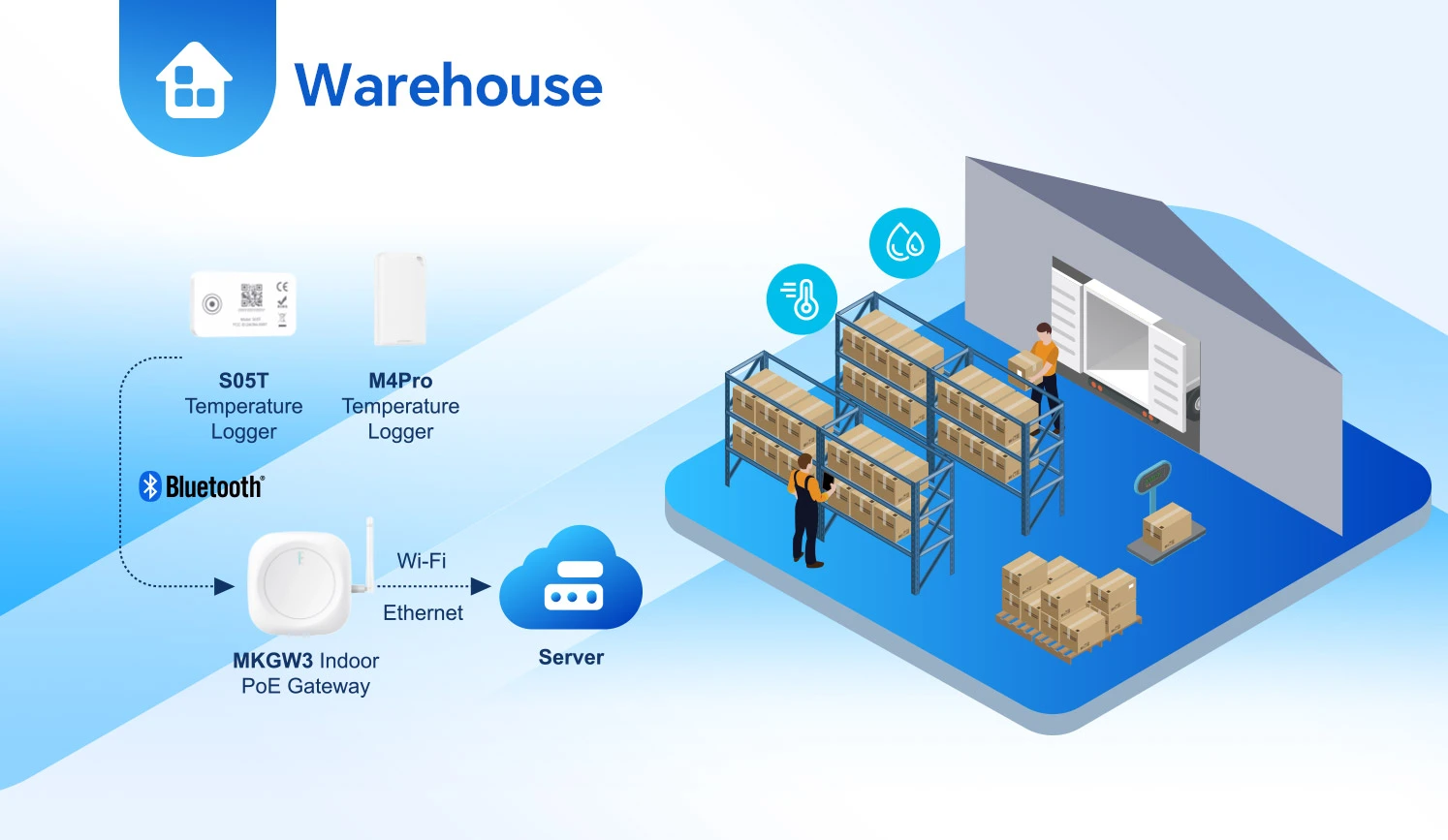
Running a cold storage facility is demanding. You have to keep track of hundreds or even thousands of fixed monitoring points. If you run two thousand freezer units, changing every battery each year becomes a major staffing burden. That is why BLE loggers are ideal for warehouse temperature monitoring. You simply mount them and leave them in place for years of maintenance-free logging. When the temperature in a particular freezer unit drifts out of range, an alert lands on your phone. Staff can then go straight to that aisle instead of walking the entire floor.
Transportation
Loading and unloading are often harder on a cold chain than highway driving. Doors sit wide open in the summer heat. Temperature and humidity sensors, together with door sensors, tell you exactly what happened. They show whether the door was opened when it should stay shut, when the temperature begins to rise, and where the truck is at the time. In cold chain logistics, monitoring gives you facts instead of assumptions.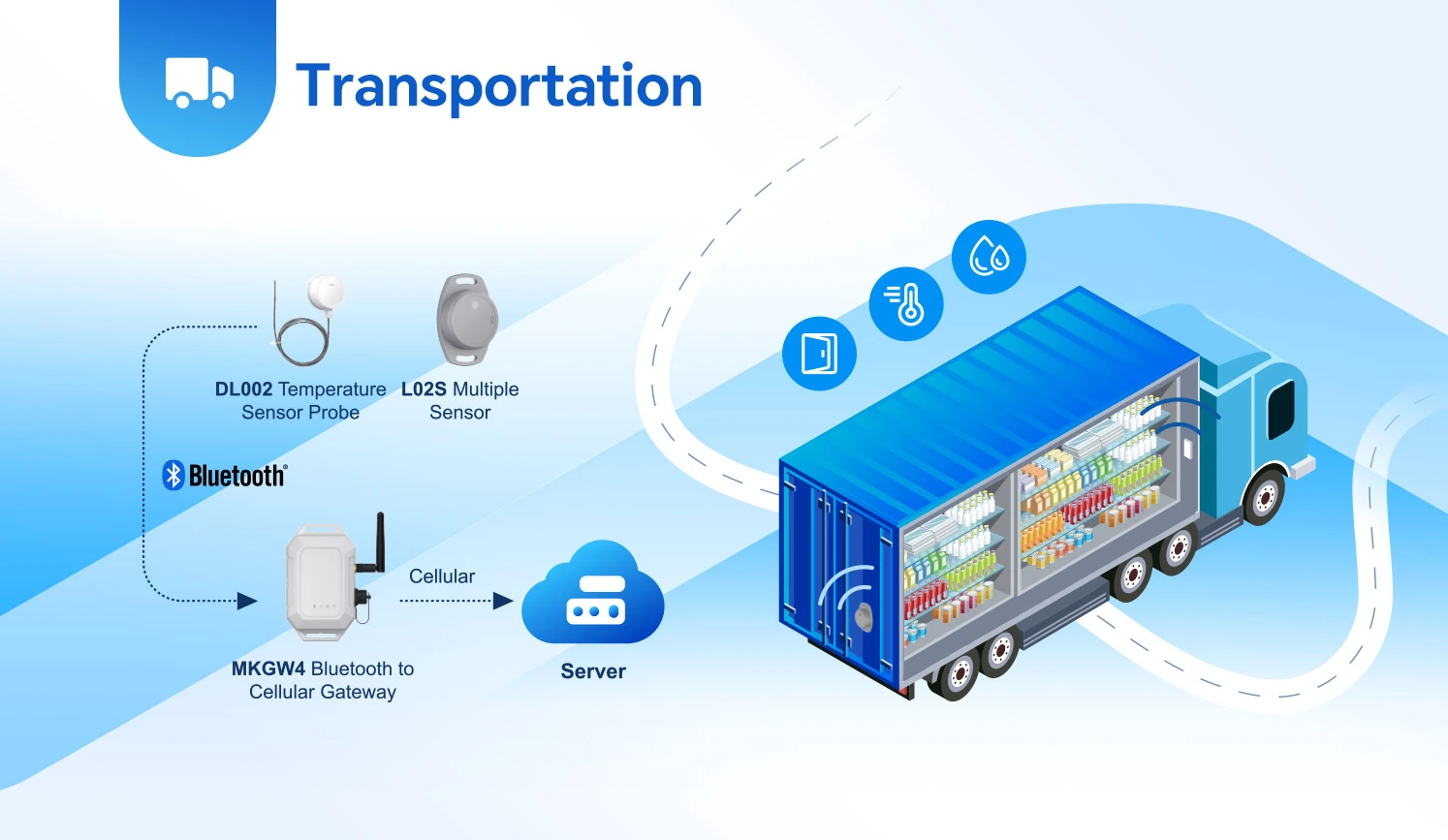
Retail
In a supermarket, a broken display case is a silent killer. Customers won’t notice the temperature is off, but thousands of dollars in dairy or deli meat can spoil overnight. BLE temperature sensors are a practical choice for this challenge. Thanks to temperature monitoring, store managers get a push notification the moment a case goes out of band, so they can fix it before the morning shift even starts.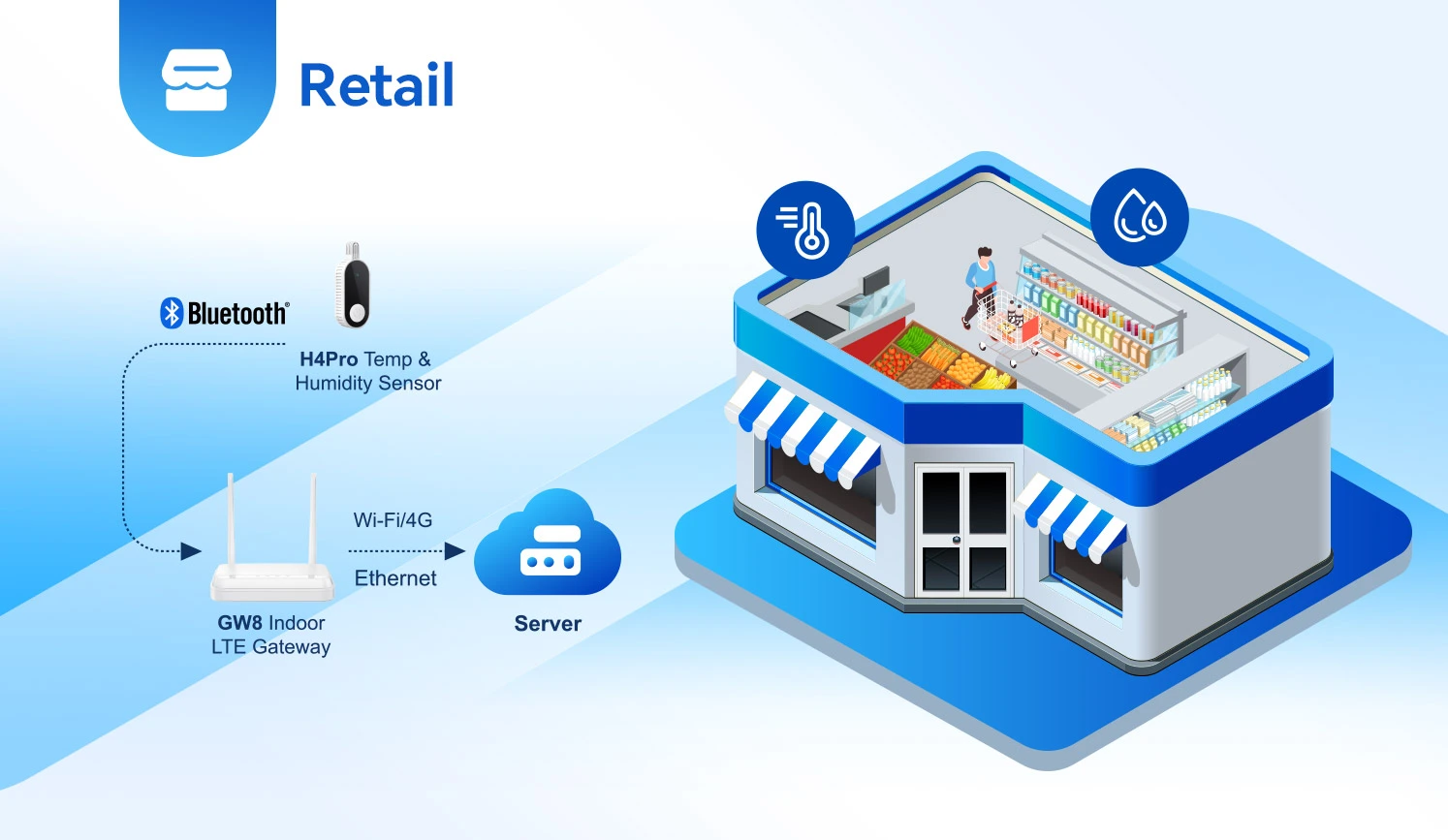
Typical Temperature Ranges for Cold Chain Products
| Product | Target Range | Consequence of Drift | Regulatory Reference |
| Vaccines, biologics | 2°C to 8°C | Potency lost, unrecoverable | WHO TRS 961, Annex 9; USP ⟨1079⟩; EU GDP 2013/C 343/01; product labeling |
| Fresh produce, dairy | 0°C to 4°C | Spoilage, shorter shelf life | FDA Food Code 2022 §3-501.16(A)(2); fluid milk: PMO / state codes ≤7 °C (45 °F); EU Reg 852/2004, Annex II Ch. IX |
| Frozen food, ice cream | -18°C or below | Freezer burn, texture breakdown | Directive 89/108/EEC; Commission Reg (EC) No 37/2005 + EN 12830; Codex CAC/RCP 8-1976 |
| Seafood | −18 °C or below (general); −30 °C or below (tuna / sashimi-grade) | Bacterial growth, off-flavors | EU Reg 853/2004, Annex III Section VIII; FDA Fish & Fishery Products Hazards and Controls Guidance; buyer specs |
| Ultra-cold mRNA vaccines | −90 °C to −60 °C (Comirnaty ULT storage) | Total loss | FDA-approved product labeling / Pfizer Comirnaty PI; CDC Vaccine Storage and Handling Toolkit |
Note: Ranges shown are typical reference values. The product’s stability data and the manufacturer’s labeled storage conditions always take precedence.
A temperature sensor rated ±0.5°C works for frozen food. For pharmaceuticals, temperature monitoring audits typically expect ±0.3°C or better. Match the temperature sensors accuracy to the product tolerance before you price anything.
MOKOSMART Cold Chain Hardware Solutions and Products
MOKOSMART provides cold chain hardware solutions for cold storage warehouses, long-haul transport, and retail display cases.
MOKOSMART designs a cold chain temperature monitoring hardware solution with the S05T temperature logger for a Mexico-based transportation fleet. The S05T disposable temperature logger captures readings in real time and stores up to 60,000 of them. With on-board gateways, fleet managers can check cargo conditions on the cloud platform, so there are no blind spots and no waiting for the truck to arrive.
MOKOSMART’s automated cold chain monitoring system for food safety runs around the clock at a supermarket in Ghana. If temperatures start to drift, staff get an alert right away. This lets them act fast before any food goes bad. The system also generates compliance reports automatically. That means no missed checks and no spoiled stock.
MOKOSMART offers a focused portfolio of BLE and LoRaWAN® devices for cold chain hardware solutions, balancing cost, battery life, and real-time visibility.
BLE Sensors
L02S: L02S is an all-in-one condition monitoring sensor, watching temperature, humidity, door status and motion. The condition monitoring sensor can hold 60,000 data groups in its memory and runs on a replaceable battery that lasts up to 5 years.
S05T: S05T is a disposable, ultra-thin temperature sensor. The logger is designed for cost-effective, single-use shipment tracking with 60,000 data storage and IP67 protection.
DL002: DL002 is a durable temperature probe supporting PT100, NTC, and SHT40 sensors. It features a 5-year battery life and a detachable probe for easy recalibration in harsh environments, making it a reliable choice for long-term temperature monitoring.
LoRaWAN® Logger
DL001-LW: DL001-LW is a long-range data logger with a local display. It offers ±0.3°C accuracy, built-in flash storage for offline logging, and IP66 protection. It transmits data up to 7 km via LoRaWAN®, making it suitable for warehouses temperature monitoring and large facilities.
Looking for a customized cold chain hardware solution? Contact MOKOSMART today for ideal options and tailored hardware solutions.